

In constitutional democracy, the two-chamber structure has an essential effect on the State system. Due to this structure, the principle of separation and balance of legislative, executive and judicial powers is always adhered to. It is aimed to protect the rights of individuals against the risks involved in the concentration of power. Legislative power is thus entrusted to both the Sejm and the Senate to prevent the negative effects of concentration of power within a parliamentary majority.
As evidenced by the history of the Polish parliamentary system, there is a link between the two-chamber parliament structure and the sovereignty of the State, in its traditional meaning. Such a link could be seen again when the Senate was re-established following a number of constitutional reforms, initiated in 1989.
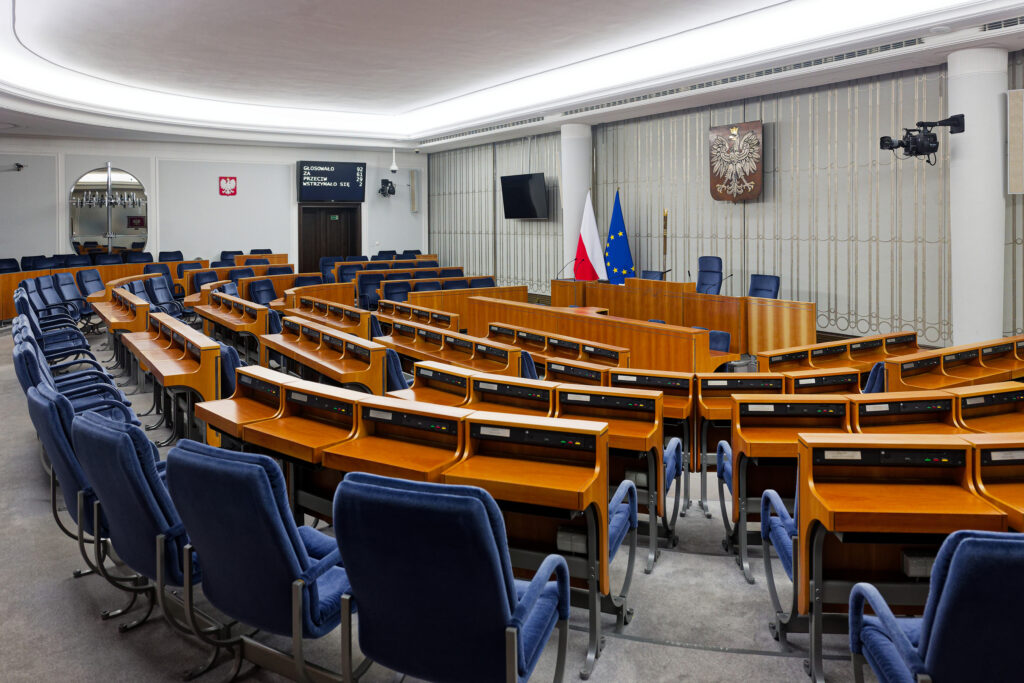
In accordance with the Constitution of the Republic of Poland, the Senate consists of 100 senators elected by direct and universal ballot, by secret vote. As set out in the Election Code, these are majority elections, held in single-member constituencies. The Senate is thus a repository of democratic legitimacy on an equal footing with the Sejm.
In the spirit of the Polish parliamentary system, the Constitution and its practical application presuppose an imbalance between two parliamentary chambers. It is the Sejm that ultimately gives shape to the text of statutory acts submitted to the President of the Republic of Poland for signature and it is the Sejm that may reject the President's veto. Only the Sejm is authorised by the Constitution to appoint the government and exercise control over its functioning, to select judges of the Constitutional Tribunal and the State Tribunal, and to hold the most important bodies and State officials accountable before the State Tribunal. As for the latter, there are two exceptions: the Sejm cannot hold the President of the Republic of Poland accountable or form an indictment against him (the National Assembly with senators is required for this purpose) and it cannot hold a senator accountable for breaching a prohibition of business activity as this issue is dealt with by the Senate in a vote. The end of the Sejm's term means that the Senate's powers are no longer in force.
Nonetheless, both chambers have equal powers to amend the constitution. The Senate, too, has the right to initiate constitutional amendments. The Sejm may only amend the Constitution with the Senate’s consent given by an absolute majority of votes, in the presence of at least half of the statutory number of senators, within 60 days of the adoption of the relevant constitutional amendment.
Both chambers enjoy equal rights to adopt, by the majority of 2/3 votes in the presence of at least half of the statutory number of its members, an act approving the ratification of an international agreement under which the competence of national authorities is to be transferred in some matters to an international body or an international organisation. The Council of Ministers cooperates with the Sejm and the Senate on matters relating to the Republic of Poland's membership of the European Union, in particular EU law-making, bringing actions to the Court of Justice of the European Union, and holding Presidency in the Council of the European Union. The Senate may adopt a resolution on bringing an action before the Court of Justice of the European Union on grounds of infringement of the principle of subsidiarity by an eu legislative act.
When sitting in joint session, the Senate and the Sejm act as the two fully equal components of the national assembly. The presence of both senators and deputies is equally important for the performance of its functions, i.e. taking the presidential oath of office and hearing the President’s address. Senators and deputies vote on an equal footing when the National Assembly adopts a resolution on indicting the President before the State Tribunal or on declaring the President permanently unable to hold office due to health reasons. The Marshal of the Senate takes on the duties of the President of the Republic of Poland, on a temporary basis, when the Marshal of the Sejm is unable to do so.
As one of the two bodies of the legislative authority, the Senate has the right to initiate legislation and participates in the adoption of legislative acts. However, an opinion of the Senate on an act passed by the Sejm may be rejected by an absolute majority of votes cast by at least half of the statutory number of deputies. The Senate does not take part in examining acts vetoed by the President, however, it does take part in removing constitutional discrepancies of an act identified by the Constitutional Tribunal at the request of the President, who may send an act to the Tribunal before it is finally signed by the head of the State.
According to the Constitution, the Marshal of the Senate or a group of at least 30 senators is entitled to lodge with the Constitutional Tribunal requests for verification of the constitutionality of a statutory act, as well as the constitutionality of the objectives or activities of political parties.
Another role which is essential for the constitutional structure of the State – a role which has evolved in practice over the years and which is based on the Rules and Regulations of the Senate – is associated with actions taken by the senate to enforce decisions of the Constitutional Tribunal on legislative acts. The Marshal of the Senate forwards the decision of the Constitutional Tribunal on the consistency of an act to the Constitution to the Legislative Committee, which checks if any legislative measures have to be initiated. In such a case, the Committee requests the Marshal of the Senate to undertake legislative initiative.
The Senate has the right to approve the decision of the President of the Republic of Poland on a nationwide referendum on issues which are especially important for the State. Resolutions on such issues are adopted by the Senate by an absolute majority of votes in the presence of at least half of the statutory number of senators. The Senate can also put forward a motion to the Marshal of the Sejm for a nationwide referendum by presenting proposals of questions or possible solutions to the issue to which the referen- dum relates.
The Senate also considers petitions that can be filed by citizens who can exercise such a right under the Constitution. The Marshal of the Senate for- wards a petition to the Petitions Committee, which considers it on its own or refers it to a competent public administration authority. The process of con-sidering the petition may result in the Committee's submitting a request for legislative initiative, along with a draft act, to the Marshal of the Senate.
The Senate is entitled to elect and approve the appointment and dismissal of state bodies. The Senate appoints and dismisses two senators who are members of the National Council of the Judiciary and two members of the College of the Institute of National Remembrance – the Commission for the Prosecution of Crimes against the Polish Nation, and it appoints and dismisses a member of the National Broadcasting Council, a member of the State Commission for the prevention of sexual abuse of minors aged under 15, and three members of the Monetary Policy Council. It is the Senate whose approval is required, after clarifications are provided by interested parties and answers are given to senators’ questions, for the appointment of the Commissioner for Human Rights and the lay judges of the Supreme Court, and it is the Senate that approves the appointment and dismissal of: the President of the Supreme Audit Office, the Commisioner for Children's Rights, the President of the Personal Data Protection Office, and the President of the Institute of National Remembrance – the Commission for the Prosecution of Crimes against the Polish Nation.
The Senate hears reports submitted by the National Broadcasting Council. Rejection of the report by the Senate is one of the grounds for terminating the term of office of all Council members. Additionally, the Senate hears reports and information provided by the Constitutional Tribunal, the National Council of the Judiciary, the National Media Council, the First President of the Supreme Court, the Commissioner for Human Rights, the Commisioner for Children's Rights, and the President of the Institute of National remembrance. The Upper Chamber also considers the information provided by the Council of Ministers about Poland’s involvement in the work of the European Union, as well as information about the matters relating to the Polish Diaspora and poles living abroad.
In practical terms, the performance of constitutional tasks by the Senate entails a certain supervisory function, in particular, by requiring representatives of the government to be present and provide the information needed for the legislative work of the Senate or connected with Poland's membership in the European Union. This significant supervisory role manifests itself in differentways, for example, it may take the form of statements of senators, issued within the framework of their mandate, to which members of the Council of Ministers have to reply in writing.
The Senate is involved in international cooperation, in line with the tradition of the Second Republic of Poland and the current practice. This can be seen, for example, in the Senate’s cooperation with Organizations of the Polish Diaspora in different countries across the world.
Ryszard Piotrowski