

First sitting
At the beginning of a new term, the Senate of the Republic of Poland usually meets for the first time on the same day as the Sejm. The first sitting is convened by the President of the Republic of Poland within 30 days of the election. The opening of the first sitting marks the beginning of the four-year term of office of both houses of Parliament.
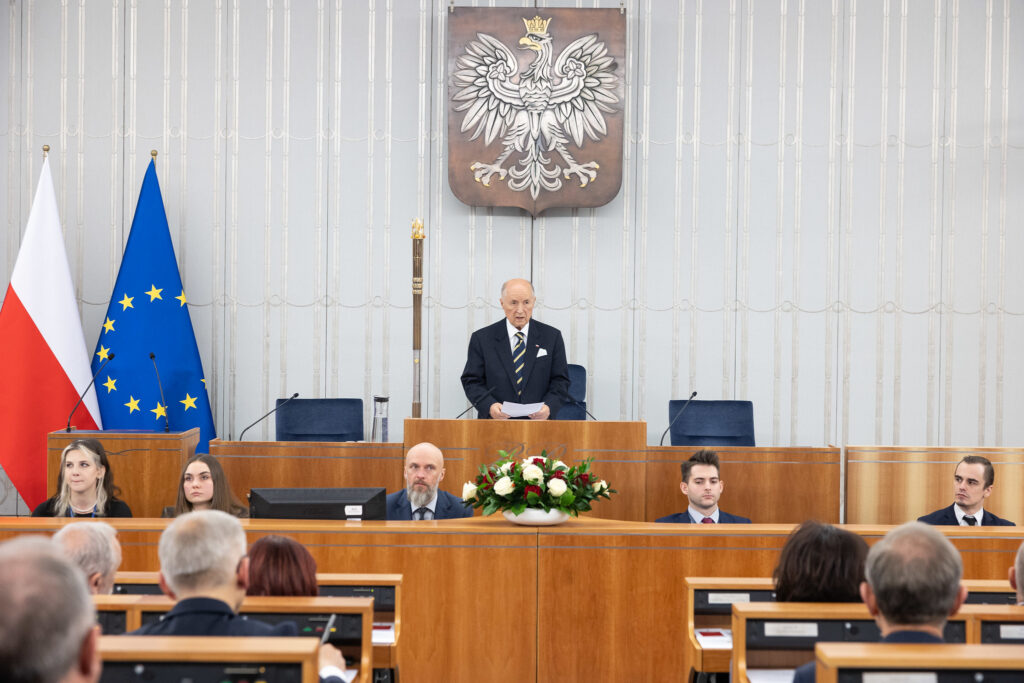
The sitting is opened by the President of the Republic of Poland, who delivers an address and appoints the oldest senator as the Senior Marshal. The Senior Marshal takes the oath of office and presides over the first part of the sitting.
I solemnly swear to perform my duties to the Nation diligently and conscientiously, to safeguard the sovereignty and interests of the State, to do everything for the prosperity of the Homeland and the well-being of its citizens, and to observe the Constitution and other laws of the Republic of Poland.
The oath may be supplemented with the words: “So help me God.”
First sitting – step by step
-
Convening the sitting
The President of the Republic of Poland convenes the first sitting of the Senate within 30 days of the election.
-
Opening the sitting
The President of the Republic of Poland opens the sitting, delivers an address and appoints the Senior Marshal.
-
Senators take the oath of office
The Senior Marshal appoints three secretaries of the first sitting and, with their assistance, administers the oath of office to the senators present in the chamber.
-
Election of the Marshal of the Senate
The Senate proceeds to elect the Marshal of the Senate. A senator nominated by at least 10 senators may stand as a candidate. The voting procedure is laid down in Article 6(2) of the Rules of Procedure of the Senate.
-
Election to the remaining offices
Following the election of the Marshal of the Senate, the Deputy Marshals and Secretaries of the Senate are elected.
Committee work
The Senate establishes standing committees, which deal with specific areas of business in accordance with the remit of each committee, as set out in Annex 1 to the Rules of Procedure of the Senate. The Senate may also establish special committees to carry out specific tasks. In such cases, it also elects the chairs and members of those committees.
Among other things, committees consider Acts passed by the Sejm as well as draft bills and draft resolutions initiated by senators. The results of committee work are presented to the Senate during plenary sittings in the form of reports or opinions.
-
Standing committees
They deal with specific areas of business, in accordance with the remit of each committee.
-
Special committees
They are established by the Senate to carry out specific tasks.
-
Work on legislation
Committees consider Acts passed by the Sejm as well as draft bills and draft resolutions initiated by senators.
-
Reports
The results of committee work are presented to the Senate during plenary sittings in the form of reports or opinions.
Plenary sittings
No later than seven days before a scheduled sitting, the Marshal of the Senate notifies senators of the date of the sitting and the draft agenda. The draft agenda is first considered by the Council of Elders.
Each sitting of the Senate begins with the adoption of the agenda or the introduction of amendments to it, consisting of:
- adding new items to the agenda;
- removing existing items; or
- changing the order in which items are considered.
Article 45 of the Rules of Procedure of the Senate specifies the matters that may, in particular, be considered by the Senate. These include:
- Acts passed by the Sejm;
- Senate legislative initiatives and other resolutions;
- reports and information presented to the Senate by, among others, the Constitutional Tribunal, the National Council of the Judiciary, the First President of the Supreme Court, the Commissioner for Human Rights, the Commissioner for Children’s Rights, the National Broadcasting Council, the National Media Council and the President of the Institute of National Remembrance;
- information presented by the Council of Ministers and its members, including information concerning the Polish diaspora and Poles abroad.
Course of a plenary sitting
-
Agenda
The Senate adopts the agenda, which has previously been considered by the Council of Elders.
-
Committee reports
The competent Senate committee presents its report, after which senators may put questions to the rapporteur.
-
Debate
A representative of the Government takes the floor, after which senators may put questions. The debate is then opened, during which senators take the floor and may submit legislative motions. The Marshal may give the floor out of turn to the rapporteur and the chair of the committee, while the President of the Republic of Poland, the Prime Minister and members of the Government may take the floor at any time during the sitting.
-
Voting
Once the debate has been closed, the Marshal calls a vote. As a rule, votes are held towards the end of the sitting.
-
Announcement of results
The Marshal announces the results, which are simultaneously displayed on the electronic boards in the chamber.
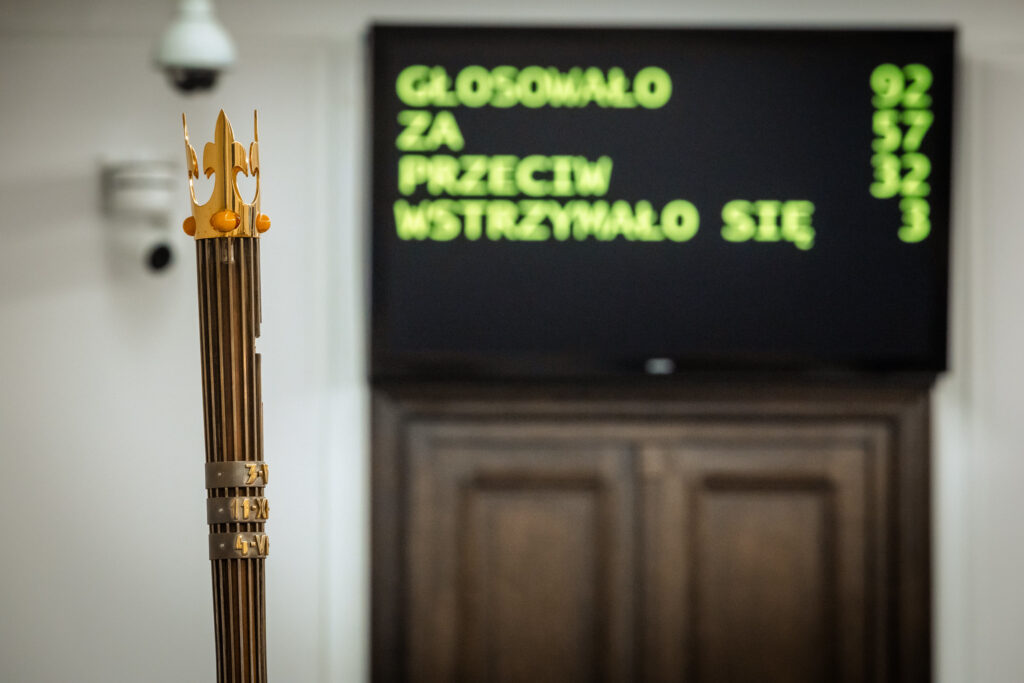
Traditionally, every plenary sitting of the Senate of the Republic of Poland is opened and closed by the Marshal striking the floor three times with the Marshal’s staff. This custom dates back to the beginnings of Polish parliamentarism, and the staff itself is regarded as a symbol of power, authority and dignity.
Voting
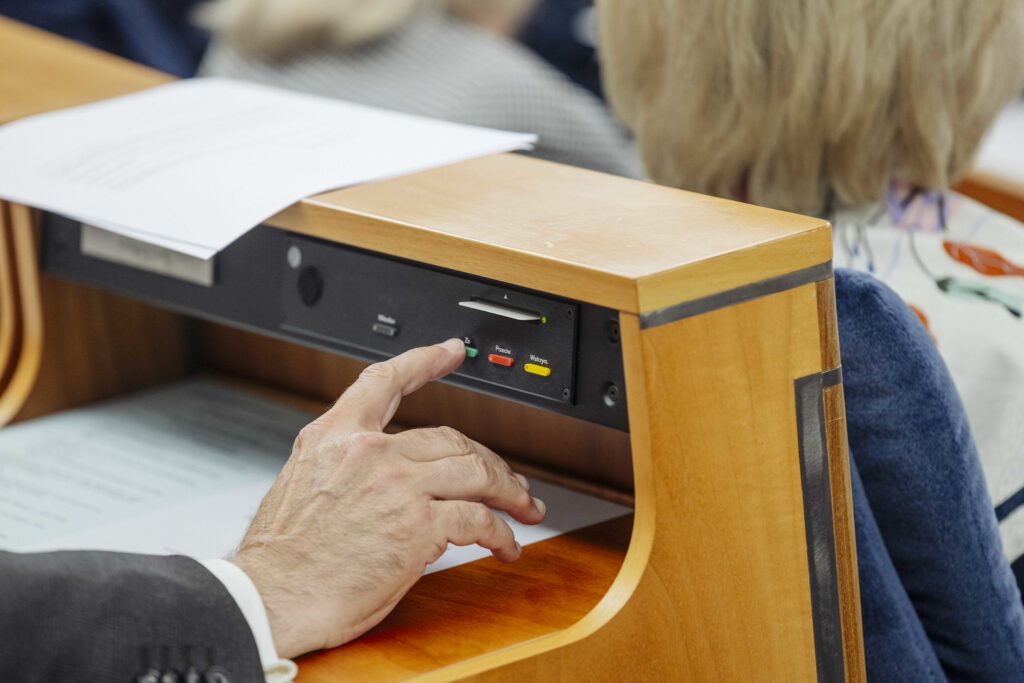
For the duration of the term of office, each senator is issued with an electronic voting card. Senators’ seats in the chamber are equipped with consoles that enable them to cast their votes.
-
Voting card
The senator inserts the card into the reader to access the voting system.
-
Casting a vote
At the appropriate time, the senator selects one of three options: “for”, “against” or “abstain”.
-
Results
Once voting has ended, the system counts the votes. The results are displayed in the chamber and announced by the Marshal. The system also generates a printout listing the senators present and indicating how each of them voted.
-
Secret ballots
In personnel matters, votes are usually held by secret ballot, using stamped ballot papers.
Support for sittings
-
Legal support
Legislative counsel prepare legal opinions, assist senators in analysing Acts, provide clarification on legal issues, compile lists of amendments and ensure that resolutions are correctly drafted in accordance with the principles of legislative drafting.
-
Organisational support
Staff of the Chancellery of the Senate prepare schedules of Senate sittings, draft agendas, Senate papers, sitting scripts and minutes, and compile documentation relating to Senate sittings.
-
Voting system
IT staff are responsible for ensuring the proper operation of the electronic voting system and prepare printouts of voting results.
-
Verbatim reports
The Verbatim Reports Unit prepares verbatim reports, i.e. written records of the proceedings.
Documentation of proceedings
Information on the agenda and resolutions adopted by senators is available on the website www.senat.gov.pl. Senate sittings are streamed live online and recorded as digital audio and video files. Audio recordings are continuously divided into five-minute segments, which are automatically converted from speech to text, i.e. transcribed, and then edited for language and style.
The edited transcript segments are progressively combined and published on the Senate website as a working version of the verbatim report, usually within two hours of the relevant statement being made.
During a sitting and immediately after it has ended, senators may submit comments on the content of the transcript. Only changes that clarify the record of a statement are permitted. No new wording, arguments or justifications may be added.
Thirty days after the end of a sitting, the verbatim report is printed and published on www.senat.gov.pl. It constitutes the official record of the proceedings and contains the revised and consolidated working transcripts from each day of the sitting, speeches submitted for the record during the debate, senators’ statements and roll-call voting results.