
Interwar period
After 123 years of partitions, millions of Poles lived outside the borders of the restored Polish State – mainly in the United States, Germany, France and Brazil. The authorities of the newly re-established Republic of Poland recognised that an organised Polish diaspora could become an important ally in pursuing the country’s foreign and economic policies. It was decided that the Senate, as a prestigious institution that was at the same time less involved in day-to-day party politics than the Sejm, should act as a patron of Polish diaspora communities. The Senate of the Second Republic of Poland therefore began working to bring together dispersed Polish communities abroad and maintain their ties with their homeland.
-
First Congress of Poles from Abroad
The Congress was held in 1929. An Organisational Council was established to coordinate initiatives concerning the Polish diaspora. Marshal of the Senate Juliusz Szymański became its President.
-
Second Congress of Poles from Abroad
The Congress was held in 1934. During the Congress, the World Union of Poles from Abroad, known as “Światpol”, was established, bringing together most Polish diaspora communities. It was headed by Marshal of the Senate Władysław Raczkiewicz. “Światpol” sought to strengthen ties between Polish emigrants and their homeland, cooperated with Polish educational and cultural organisations abroad, raised funds and provided financial support to Polish diaspora publications in order to promote Polish culture and preserve a sense of national identity, particularly among the younger generation born abroad.
Activities since 1989
The re-established Senate of the Republic of Poland broke with the legacy of the Polish People’s Republic, whose authorities had been hostile towards the émigré community, and, drawing on the traditions of the interwar period, once again assumed responsibility for supporting Poles living outside their homeland. In 1990, the „Wspólnota Polska” Association was established, with Professor Andrzej Stelmachowski, Marshal of the Senate of the first term, as its President. This created an independent non-governmental organisation linking Poland with the Polish diaspora. It cooperated with official diplomatic missions and State authorities, which initially lacked the trust of the pro-independence émigré community.
In 2002, the Senate adopted a resolution establishing the Polish Diaspora Consultative Council to the Marshal of the Senate. Its members included representatives of Polish diaspora organisations from around the world. The Council is an advisory body. It provides opinions on matters concerning the Polish diaspora and its tasks include giving opinions on draft bills and resolutions in this area. In this way, the Polish diaspora and Poles abroad gained a voice in Polish State policy on matters affecting them. After a hiatus of several years, in 2024 Małgorzata Kidawa-Błońska, Marshal of the Senate of the eleventh term, revived the tradition of appointing the Council. In 2025, she also established the Polish Diaspora Youth Council. Its tasks include giving opinions on matters of importance to young Poles abroad and on initiatives concerning Polish diaspora youth.
The first initiatives of the re-established Senate of the Republic of Poland and their impact
Following the dissolution of the Soviet Union in 1991, millions of Poles living in the East needed support after years of communist persecution, deportations and the destruction of their culture and identity. The Senate therefore focused primarily on rebuilding Polish education and culture and providing humanitarian assistance to Poles living in countries that emerged following the dissolution of the Soviet Union. It subsequently expanded its efforts to support Polish diaspora and Polish-language education around the world. These initiatives included:
- supporting Polish diaspora cultural institutions;
- organising summer holidays for children and young people;
- fostering appropriate attitudes among the younger generation;
- providing social and charitable assistance to older people and those in need.
The Senate thus played an important role in the revival of Polish culture and identity beyond Poland’s eastern border, as well as in equally important efforts to promote Polish culture and the Polish language around the world.
Key legislative initiatives of the Senate of the Republic of Poland concerning the Polish diaspora and Poles abroad
- the Act on the Polish Card (Karta Polaka), introducing various facilitations and privileges for Poles living in the East;
- the Repatriation Act, enabling Poles, particularly those from Kazakhstan and other Asian regions of the former Soviet Union, to return to their homeland;
- enabling Polish citizens permanently resident abroad to vote in the second round of presidential elections;
- establishing 2 May as Polish Diaspora and Poles Abroad Day.
Current priorities of the Senate in supporting the Polish diaspora and Poles abroad
- encouraging civic and social engagement among Poles abroad;
- encouraging the younger generation of the Polish diaspora and Poles abroad to become more actively involved;
- organising worldwide gatherings of Polish diaspora youth;
- preserving national heritage and promoting Polish culture.
Projects for 2026 and 2027:
- strengthening Polish diaspora organisations;
- developing and professionalising Polish diaspora media.

The Marshal of the Senate extends honorary patronage to numerous initiatives and events supporting the Polish diaspora and meets with representatives of Polish communities abroad during foreign visits. Senators also hold meetings of a similar nature.
The Senate Committee on Emigration Affairs and Contacts with Poles Abroad deals with matters of importance to Poles living outside the country and works to strengthen their ties with their homeland.
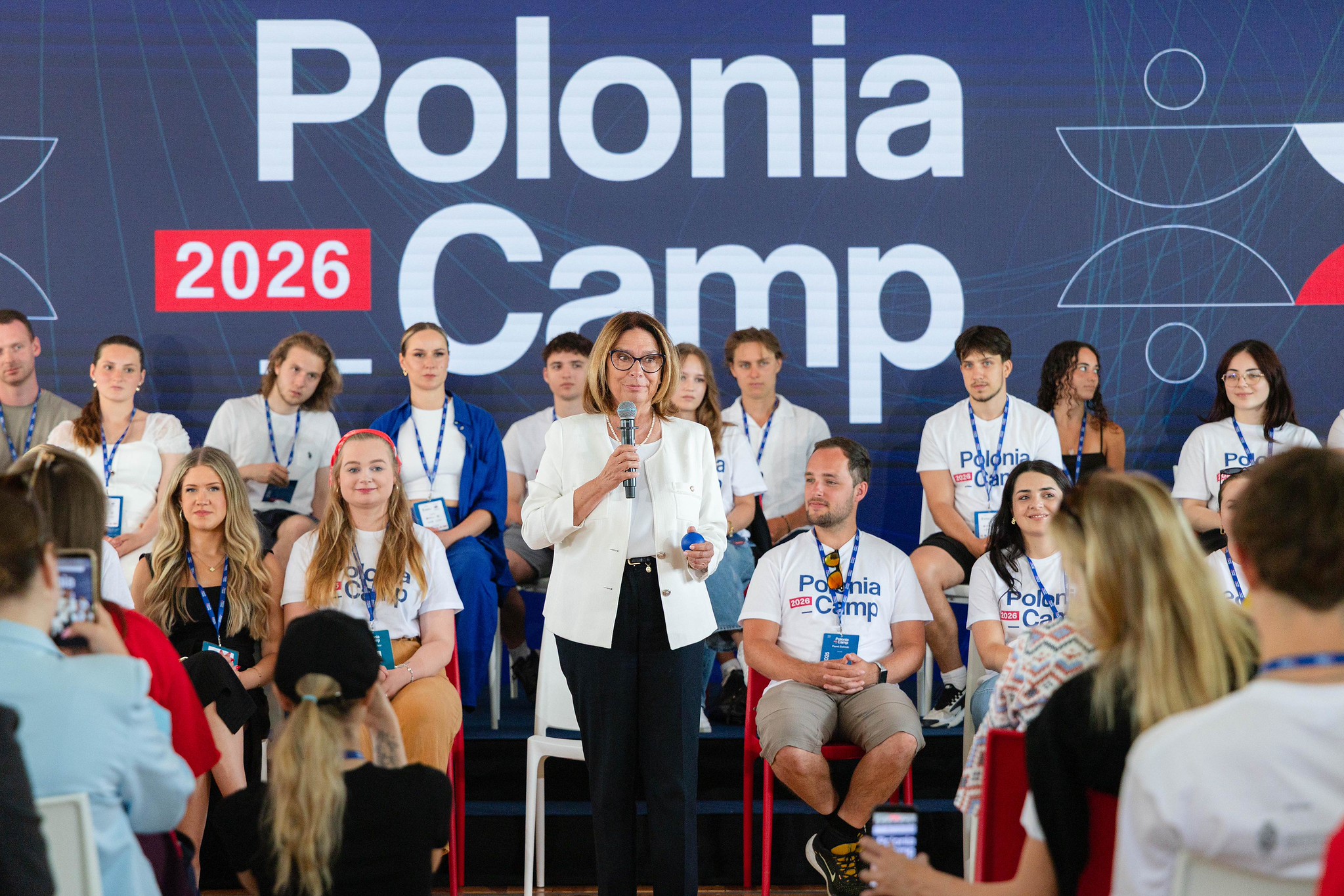
At the initiative of Marshal of the Senate Małgorzata Kidawa-Błońska, the worldwide gathering of Polish diaspora youth known as „Polonia Camp” was held in Warsaw for the second time. The event has created a new community bringing together young Poles and people of Polish descent from around the world. In 2026, approximately 1,500 people from 50 countries took part in the event.
